MiniMax Speech
Converts text into hyper-realistic speech across multiple languages and accents.
Are you the owner?
Claim this tool to publish updates, news and respond to users.
Sign in to claim ownership
Sign InDescription
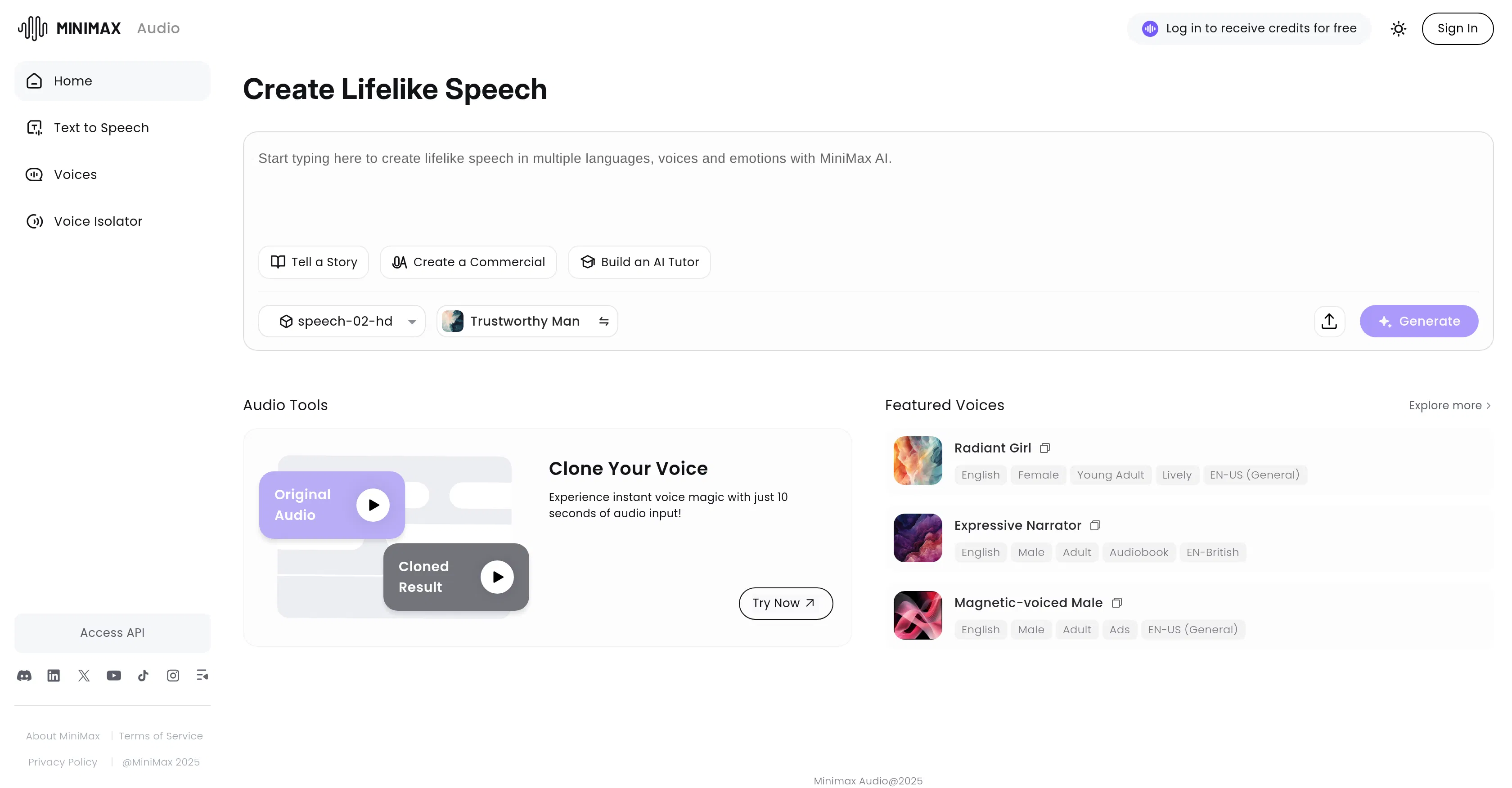
MiniMax Speech is a sophisticated text-to-speech tool developed by MiniMax, designed to construct hyper-realistic and natural-sounding audio from written text. Its primary value lies in delivering exceptionally lifelike vocal output that captures nuanced human intonation and emotion, making it a powerful asset for content creators and developers who require high-quality audio synthesis without the need for professional voice actors. The tool is engineered to support a wide range of global languages and diverse voice characteristics, providing flexibility for international projects and localized content.
Key features include the generation of speech in numerous languages and regional accents, a large library of distinct voice types ranging from different ages and genders to specific emotional tones, fine-grained control over speech parameters such as pitch, speed, and emphasis for custom delivery, and the ability to produce long-form audio content suitable for audiobooks or presentations. It also supports batch processing for efficient conversion of large text volumes and offers an API for seamless integration into automated workflows and applications.
What sets MiniMax Speech apart is its specific focus on achieving a level of realism that minimizes the robotic quality often associated with synthetic speech, utilizing advanced deep learning models trained on extensive voice datasets. The tool is accessible primarily as a cloud-based API, allowing for integration into various platforms, websites, and mobile applications, and it includes developer-friendly documentation and SDKs. Technical details involve state-of-the-art neural network architectures that model prosody and phonetics to produce natural-sounding speech rhythms and inflections.
Ideal for podcast producers and video creators needing voiceovers, e-learning developers creating engaging educational materials in multiple languages, and software developers building accessible applications with voice interfaces or interactive assistants. It is also highly useful for businesses creating multilingual customer service announcements, marketers producing localized audio advertisements, and authors converting written works into audiobooks with expressive narration.